

Success story
End-to-end
Transport Optimization for Truck Logistics
Avoid costly expedited shipments with long term, end-to-end transport plans that account for every operational constraint.

reduction
in expedited shipments
3 months
of end-to-end
transport planning
saved within the company’s
European market
for optimization
review and execution
A company managing large-scale truck logistics operations struggled to plan transportation efficiently amid limited visibility and frequent disruptions.
Uncoordinated planning decisions often led to costly expedited shipments, inefficient resource allocation, and difficulty keeping up with market demand.
Complex exceptions and edge cases across the transport network still required significant manual intervention from planners.
Rulex optimized transport plans across the entire network by combining transport data, business constraints, and optimization within a single workflow. It generated execution-ready plans that accounted for complex exceptions and real-world trade-offs, reducing the need for manual intervention while giving planners greater visibility into future transport operations.
Closing the gaps between planning and execution in transport optimization
Planning began by consolidating the data needed to run transportation across the network – shipment details and priorities, supplier and plant requirements, distribution-center capacity and hours, carrier calendars and costs, loading limits, delivery dates, and penalties – into a single Rulex workflow, avoiding the need to coordinate multiple tools.
It managed minimum and maximum quantities, split shipments across trucks where necessary, and took into account loading constraints, searching across schedules to identify the option that balanced time, cost, and operational requirements.
Planners could configure and adjust the solution through a simple drag-and-drop interface.
The optimization logic was built around the company’s actual data and consistently produced execution-ready plans that respected both violable and non-violable requirements. This level of exception and edge-case management is often where traditional TMSs fall short – a gap that integration with the Rulex Platform can close. (To learn more about how Rulex integrates with and enhances APS and TMS systems, see here.)
The resulting plans covered a horizon of up to three months, giving planners earlier visibility into future capacity issues and potential bottlenecks. Daily optimization runs could still be completed in under one hour, allowing plans to be refreshed as demand, availability, or operational conditions changed.
More broadly, this reflects Rulex’s Decision Intelligence approach to supply chain planning: data preparation, optimization, business constraints, and execution-ready outputs are managed within the same framework.
Outcomes at a glance
The solution demonstrated how Rulex can support the complete truck transport optimization workflow:
- Up to 3 months of end-to-end transport planning, helping teams anticipate future bottlenecks.
- Daily schedules, computed in under one hour, keeping plans aligned with real-time conditions.
- 70% reduction in expedited shipments, improving planning efficiency and cutting avoidable transport costs.
- 18% decrease in spot shipments, alongside a 66% reduction in time spent on manual planning tasks.
- $80 million in projected cost savings within the company’s European market.
Custom UIs for easy management of truck logistics
Rulex Studio can turn transport optimization outputs into dedicated Custom UIs designed around the needs of planners and operational teams – to make transport plans easier to review, manage and execute.
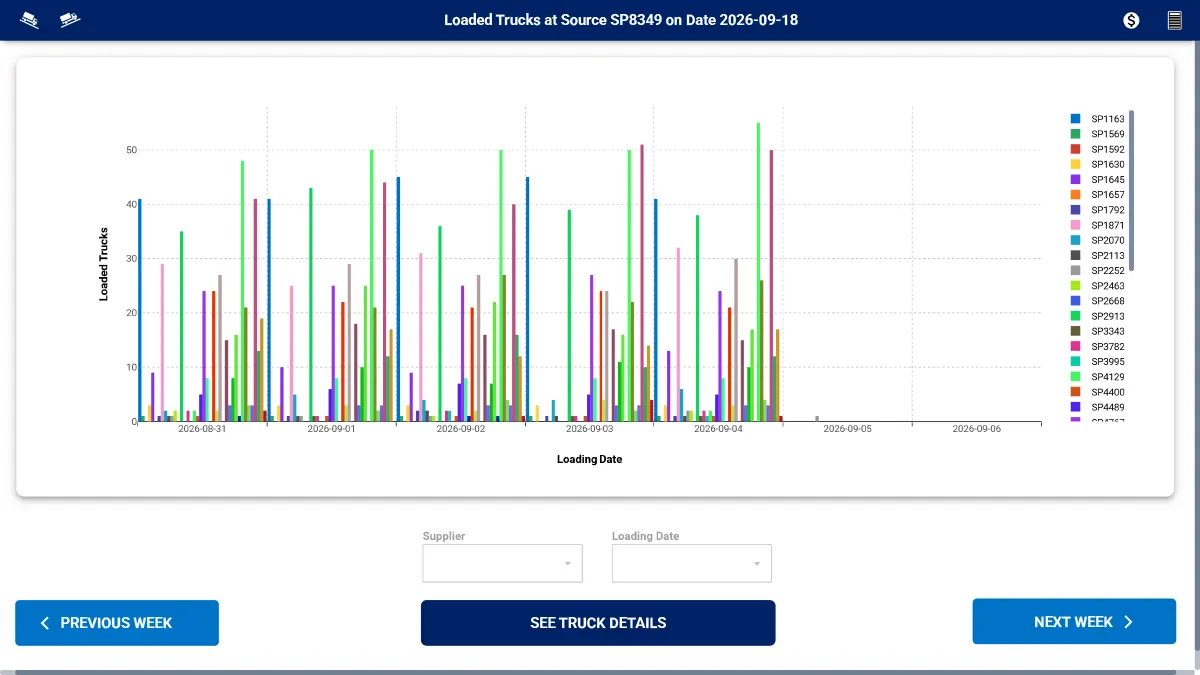
A main transport schedule overview supported the operational process, covering truck loading and supplier loading schedules, as well as the monitoring of unloading activities at manufacturing plants.
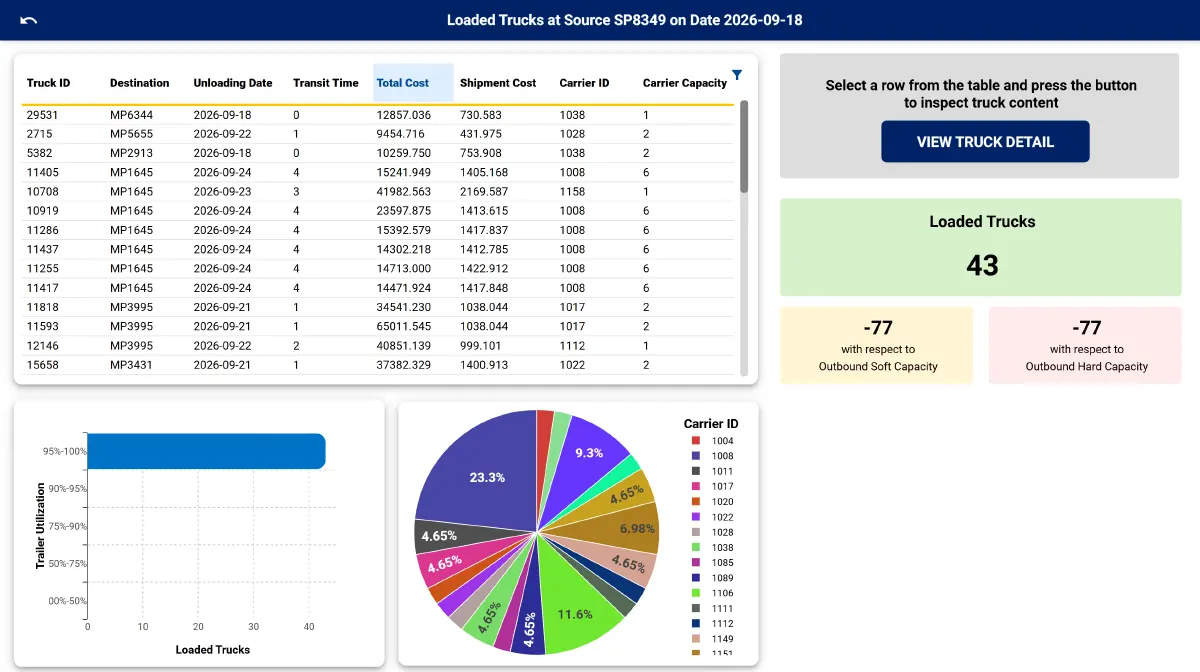
Users could move from a network-level overview to detailed truck and shipment analysis, with results aggregated either by truck or by shipment. The truck level dashboard showed trailer utilization, the number of unloaded trucks, and the comparison between inbound soft and hard capacities.
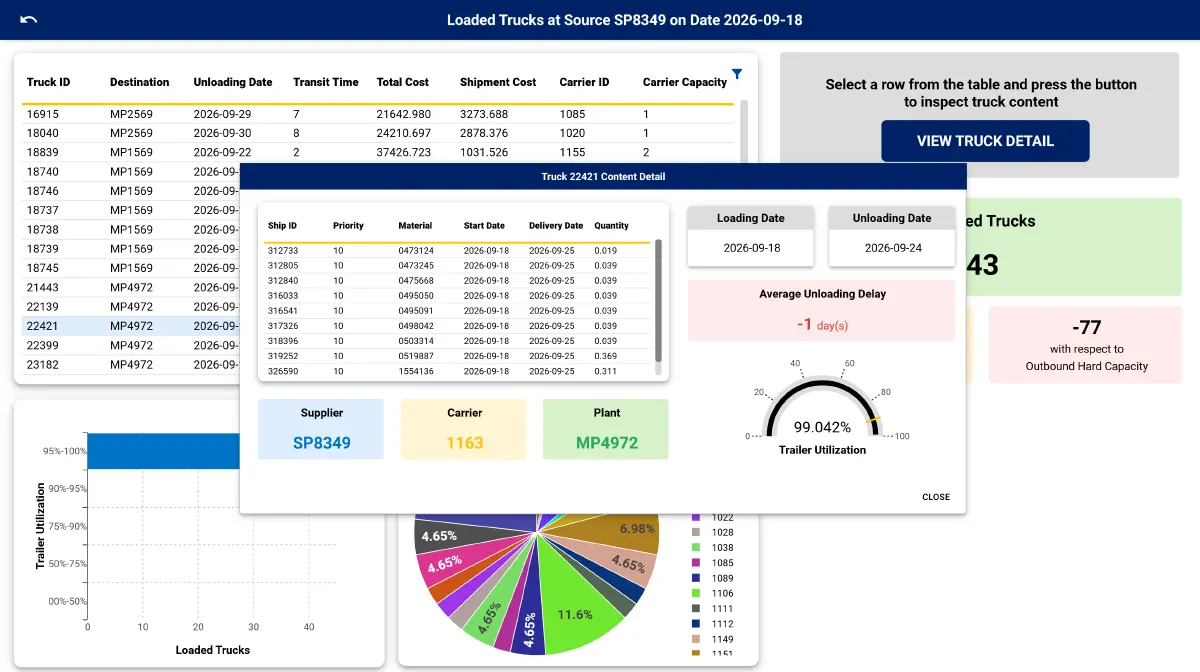
A dedicated truck content dialog displayed the shipments assigned to each truck, along with start and delivery dates, transit time, priority, and unloading delay – the latter shown through a gauge that made early and late arrivals immediately visible.
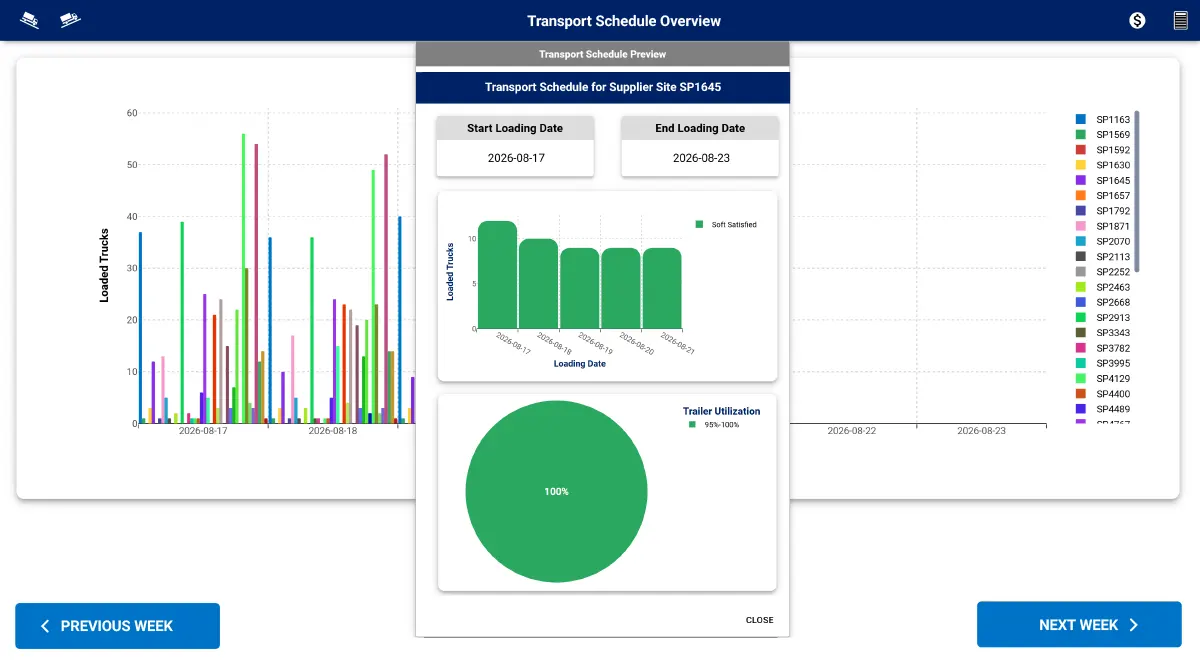
From the Transport Schedule Overview, users could also generate supplier-specific schedules and reports. Each schedule could be previewed before being sent, and included shipment-level instructions showing what should be loaded onto each truck.
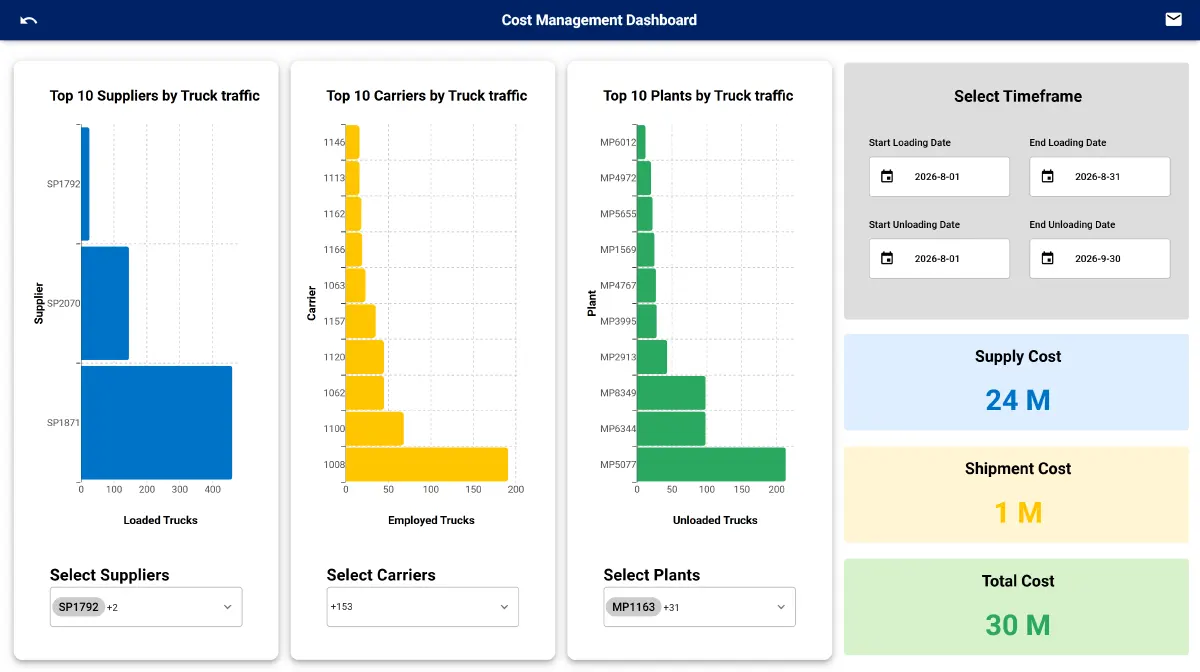
A separate cost management dashboard monitored transport performance, highlighting top suppliers, carriers, and plants by truck traffic, alongside shipment value, transport costs, penalties and total logistics costs. Reports retained the selected filters, making recurring analysis and structured reporting straightforward.
Tech point
Take a closer look at the Rulex Platform capabilities behind this transport optimization solution.

01. Data orchestration
Rulex Factory provides integrated tools to import, transform, blend, and prepare data from different sources and formats within a single visual workflow. Data is converted into a unified structure, making shipment, capacity, carrier, supplier, plant, priority, and cost information easier to reconcile and clean for optimization. Every transformation remains controlled and traceable, helping teams adapt workflows quickly as source data or requirements change.
02. End-to-end truck logistics optimization with the Transport optimizer
Rulex Transport Optimizer applies advanced algorithms to reduce logistics costs while accounting for operational constraints across the full transport plan. Through a drag-and-drop interface, planners can define priorities, shipment quantities, loading and unloading capacities, shipment splits, and target loading levels. Rulex also provides additional industry-specific and general-purpose optimization tools, helping organizations accelerate time to value.
03. Custom operational dashboards
Rulex Studio turns optimization results into tailored business custom dynamic dashboards through a visual, drag-and-drop interface. Designed around real operational processes, these dashboards allow users to review results, update inputs, trigger workflows, take action, and generate reports without switching between systems.
Why Rulex for transport optimization
Rulex supports the full transport optimization workflow – from long-term planning to operational custom UIs for shipment-level analysis, schedule generation, and cost monitoring. Where APS or TMS systems are already in place, Rulex integrates with them to add advanced optimization and close the gap between planning and execution.


Explore more supply chain case studies powered by Rulex Platform

Forecast Pharmaceutical Demand in a Changing Market
Estimating demand to align supply with market needs.
Optimize Inventory Replenishment Alongside APS
Flexibly automating planning decisions, including exceptions.

Dynamic Deployment Planning
Agilely managing disruptions across complex supply networks.
Frequently asked questions
Why choose Rulex for transport optimization?
Rulex brings data preparation and advanced optimization into one environment, along with the possibility to integrate custom interactive dashboards. Its Transport Optimizer generates and evaluates execution-ready transport plans against business objectives and operational constraints, helping companies replace fragmented planning and manual decision-making with optimized, actionable plans.
Can Rulex optimize truck loading and shipment allocation?
Yes. Rulex’s Transport Optimizer considers priorities, shipment quantities, carrier availability, loading capacities, delivery dates, costs, and penalties. It can also split shipments across trucks and identify the best feasible plan across the entire network.
Does Rulex replace existing TMS or APS solutions?
Not necessarily. Rulex can integrate with existing TMS and APS systems, adding advanced optimization and exception-management capabilities where traditional solutions leave planners to handle complex cases manually.
How can planners use truck optimization results?
Rulex Studio turns optimization outputs into tailored interfaces where planners can analyze trucks and shipments, review trailer utilization and delays, monitor capacity and costs, adjust inputs, trigger workflows, and generate supplier schedules and reports.