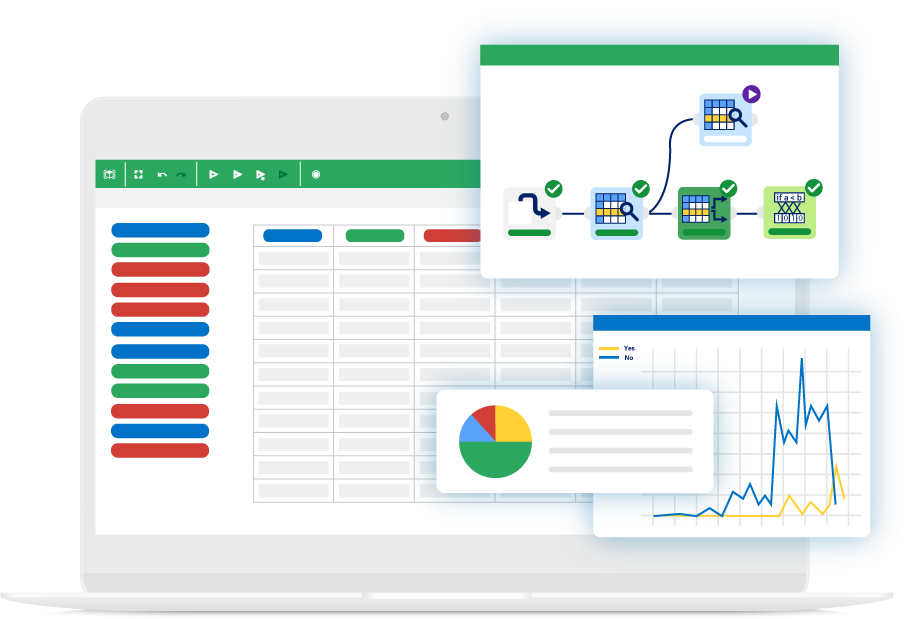


Many organizations ask whether Decision Intelligence Platforms (DIPs) and Advanced Planning Systems (APS) are overlapping technologies – or if they serve distinct purposes. The answer lies in how these tools complement one another within supply chain planning ecosystems.
APS solutions are typically central to production and supply planning. They use predefined logic to optimize schedules, inventory, and capacity. However, these systems can be rigid when businesses need to adjust to rapidly changing conditions or add domain-specific rules.
This is where Decision Intelligence Platforms add value. DIPs allow business users to visualize, edit, and test decision logic based on real-world data without relying on IT teams or recoding the APS. They introduce a layer of adaptability that standard APS tools often lack.
This article outlines how DIPs and APS can work together across four key integration scenarios, concluding with a real-world example – not just boring theory.
What actually are Decision Intelligence Platforms?
Although already up and running in the tech world, Decision Intelligence has only recently gained traction in the supply chain and manufacturing sectors. Decision Intelligence Platforms are software solutions that support, augment, and automate decision-making. They provide a unified environment for combining data, experts knowledge and advanced technologies like eXplainable AI and optimization solvers.
Decision Intelligence shifts the focus from data to decisions, allowing supply chain managers to confidently ask questions such as: “What will happen if I take this action today, given the current planning context?”, or “Which delivery plan can I implement to reduce costs, delays, and carbon footprint?”. Yes, Decision Intelligence Platforms can answer all these questions while ensuring that planners remain in the loop.
To explore the concept further, see our article: What Is Decision Intelligence? – Rulex.
3 ways Decision Intelligence Platforms and APS can work together
Decision Intelligence Platforms are not designed to replace APS systems, but rather to complement them, enhancing their capabilities and enabling more effective problem-solving. Here are four key ways these technologies work together:
(Bonus). Pre-APS implementation: reaching data maturity
Implementing APS solutions typically reveals underlying data quality issues – ranging from fragmented datasets to incomplete or inconsistent master records.
Some Decision Intelligence Platforms also provide data quality capabilities, which can be used prior to an APS roll-out to cleanse and validate data, appling business rules when possible and/or using AI to identify and correct subtle logical inconsistencies. Data consistency ensures APS deployment is faster, more accurate, and less prone to rework or delays.

1. On top of APS: adding flexibility and transparency
APS tools excel at optimizing recurring, standard processes. However, when market dynamics shift or strategic priorities evolve, their rigidity becomes a limiting factor.
Layering a Decision Intelligence Platform, like Rulex, on top of the APS, provides citizen developers with a flexible interface where they can adjust parameters, integrate external data, and use analytics capabilities to test scenarios. All without changing the core APS configuration and without IT dependency, supported by clear logic flows and decision paths that are fully traceable.
2. Integrated with APS: managing the exceptions APS can’t handle
Comprehensive as they are, APS tools may still struggle to handle highly specific operational constraints. These limitations become evident in cases such as site-level regulations or customer-specific requirements. In many organizations, such constraints are still managed manually – most often in spreadsheets – leading to inconsistencies, reduced transparency, and increased operational risk.
A Decision Intelligence Platform (DIP) enables planners to define the logic in transparent, business-friendly interfaces. Once defined, this is automatically applied across processes, ensuring that exceptions are treated systematically – reintegrating all exception-based decisions directly into the APS. This significantly reduces reliance on external tools and offline exception handling, while keeping all decision logic within a governed, enterprise framework.
3. Modular approach: instead of an APS
There are many cases where a full-scale APS implementation is not viable, due to limited budget, project timelines, or concerns about operational disruptions.
In these scenarios, a Decision Intelligence Platform can step in as a pragmatic alternative. By targeting high-leverage areas like exception handling, workforce scheduling, and demand rebalancing, these platforms deliver measurable value while coexisting with legacy infrastructure. Their modular architecture supports incremental deployment and allows organizations to scale their planning capabilities with operational requirements and available resources.
Real-world use case: optimizing production and workforce planning with Rulex and a leading APS
A global company operating in the consumer packaged goods (CPG) industry had implemented a mature Advanced Planning System (APS), successfully supporting standard production planning across the majority of its manufacturing sites.
While the system performed effectively in standard conditions, one specific facility posed a more complex challenge. Here, planners were required to optimize production schedules alongside workforce shift planning. These two planning domains were closely interdependent and under numerous constraints, including:
- Legal regulations for rest periods and shift timing
- Workforce availability and skill qualifications
- Production throughput requirements and machine capacity
The existing APS was not designed to handle this level of combined optimization. Hence, efforts to improve performance were handled separately – addressing one area at a time. This compartmentalized approach led to a disjointed planning process, where alignment between functions was limited and overall efficiency suffered. In practice, planners resorted to spreadsheet workarounds, experimenting with various scheduling options and investing a lot of time in repetitive, trial-based adjustments.
The Solution: Rulex Platform as a Decision Layer
To tackle the complexity of planning with cross-functional constraints, the team integrated Rulex Platform with the existing APS (the third case described above). The goal was to complement the existing APS – and not replace it – by introducing a solution capable of managing complex, interconnected constraints, and yet maintaining planner control and oversight.
The strategy involved the following main elements:
Intuitive constraints and objectives modeling.
Conventional optimization demands advanced mathematical formulas and specialized skills. In contrast, this approach enabled planners to independently define constraints and goals in Excel via a structured, intuitive rule syntax.
Visual interface for building decision logic.
Users could connect data sources, constraints and objectives through a drag-and-drop interface. The underlying decision logic was automatically generated by Rulex Platform, with no need for programming or modelling knowledge.
Non-disruptive optimization.
Making only those changes that were necessary, the platform produced optimized plans meeting all constraints while enhancing performance. The updated results were then fed back into the APS workflow.
Human-in-the-loop flexibility.
The platform maintained planner autonomy by allowing users to inspect, fine-tune, or override proposed plans. This made it possible for the system to accommodate local knowledge or last-minute changes.
Results achieved
The integration led to a more agile and transparent planning process, capable of handling high complexity while still keeping planners in the loop. Compared to other approaches, Rulex Platform offered significant benefits, including:
- Faster development of optimization models
- Lower reliance on external technical teams (for scripting and development)
- Shorter planning cycles
Read more real-world examples where Rulex boosted APS performance in our ebook:
Taking Your Supply Chain to the Next Level
If you’re wondering how to combine your APS with Rulex DIP, it’s definitely worth a chat. Book a free chat – let’s talk through your biggest challenges and work together to find a solution that perfectly matches your needs.
Start your decision intelligence journey