

Success story
Dynamic
Deployment Planning
Respond to disruptions by reallocating deliveries across the supply chain while balancing capacity, cost, and service levels.

faster
disruption resolution
to generate
execution-ready plans
strategies
to balance cost and
service priorities
for full planning visibility
and control
Rulex helped a global supply chain move from slow, fragmented replanning to a dynamic deployment planning approach that could automatically identify capacity-demand imbalances and reallocate affected deliveries – while keeping planners in the loop throughout the process.
The company operated in a highly dynamic environment, where demand could exceed available distribution capacity and unexpected disruptions could rapidly throw the network out of balance. When demand at a given distribution center (DC) outstripped its capacity, planners had to manually coordinate across teams to determine which deliveries could be reassigned to alternative DCs.
The process required multiple iterations of fragmented, disconnected analysis, resulting in long resolution times and plans that fell short of optimal.
From disruption detection to an executable deployment plans
Across the distribution network, shipments move continuously from plants to distribution centers, between distribution centers, and from distribution centers to final customers. Disruptions and capacity-demand imbalances were continuously monitored, allowing planners to identify where the existing plan needed to be adjusted before issues resulted in cuts.
Rulex’s Distribution Planner task supported the planning and replanning of deliveries across the network, evaluating allocations while accounting for all the relevant business and operational requirements.
For outbound deliveries from distribution centers to final customers, for example, affected shipments could be reassigned to alternative distribution centers according to the planner’s selected objective:
- Minimize transportation costs.
- Protect service levels.
- Balance cost and service performance.
At the same time, the optimization respected operational requirements such as delivery deadlines, distribution center capacity, and product availability.
Planners could review issues, adjust parameters such as distribution center capacity, filter relevant shipments, and validate or override decisions as needed before execution.
A full working day became 30 minutes
Because the Distribution Planner optimization is fast, teams can run multiple scenarios iteratively instead of relying on a long sequence of calls, emails and manual checks across neighboring distribution centers.
Once planners selected the preferred scenario, updated shipment values could be written back to the original data source, in this case SAP.
The revised deployment could then trigger downstream processes through APIs, allowing inventory assignment, distribution planning and forecasting to be realigned around the new execution reality.
The result was not only faster replanning, but a more consistent operating process: decisions that previously varied across teams became structured and traceable, while every modification could be recorded together with its rationale.
Monitor and replan from custom dashboards
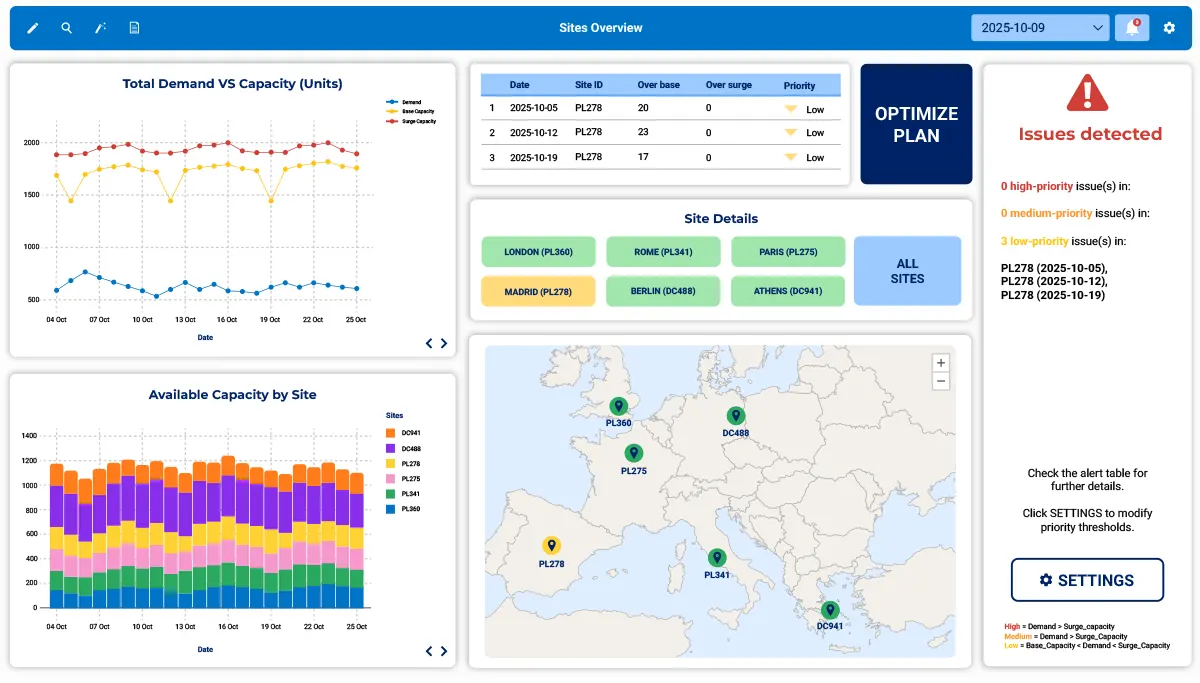
Example of a Dynamic Deployment Planning dashboard in Rulex Platform.
Rulex Platform’s dashboarding component gave planners a single environment to prioritize issues before they lead to cuts. Alerts could be integrated with existing ticketing systems, connecting disruption monitoring with established response workflows.
However the dashboard went well beyond monitoring: planners could run the optimization directly from the same interface with a single click, adjust demand or capacity, select shipments for replanning, compare scenarios, generate reports, and write approved changes back to operational systems.
Faster disruption resolution with end-to-end visibility
The solution transformed disruption management from a fragmented manual exercise into a faster and more coordinated planning process:
- Optimization in ~10 minutes. Execution-ready alternatives could be generated quickly enough to support replanning during daily operations.
- 16x faster disruption resolution. A process that previously required up to a full working day could be completed in approximately 30 minutes. Manual activities were largely automated, significantly reducing planner workload.
- Operational constraints preserved. Recommendations accounted for all requirements, always finding the best feasible plan.
- Full planner visibility and control. Proposed changes could be reviewed and approved before execution.
- End-to-end process alignment. Updated shipment plans could be written back to SAP and used to trigger downstream forecasting and planning processes.
- Traceable decisions. Changes and their rationale were visible through detailed logs, and automated reports (e.g., PDF summaries) supported communication across execution teams.
Tech point
Take a closer look at the Rulex Platform capabilities behind this dynamic deployment planning solution.

01. Network optimization with the Distribution Planner task
Part of Rulex Platform’s broader suite of vertical and general-purpose optimization solvers, the Distribution Planner is a specialized task for inventory replenishment and material allocation across production sites, distribution centers, and final customers. It accounts for delivery dates, costs, capacity, and logistics constraints to generate feasible plans within minutes, while a visual drag-and-drop interface makes it easy to configure and adapt the optimization to different supply chain scenarios and planning needs.
02. Custom operational dashboards
Rulex Studio provides tailored operational dashboards. Designed around real operational processes, these dashboards allow users to review results, update inputs, trigger replanning, and generate reports without switching between systems. Detailed logs and report generation provide visibility into decisions and help teams understand and communicate how disruptions were resolved.
03. Connected planning and APIs
Updated plans can be written back to data sources, such as SAP, and connected with downstream planning processes. APIs can trigger subsequent forecasting, while inventory assignment and distribution planning can be rerun based on the updated deployment plan.
Why Rulex for dynamic deployment planning
Supply chain planning doesn’t operate in static conditions. Rulex connects optimization tools with interactive operational dashboards and human-in-the-loop decision-making, bringing disruption detection, replanning, and execution into a single adaptive workflow.


Explore more supply chain case studies powered by Rulex Platform

Forecast Pharmaceutical Demand in a Changing Market
Estimating demand to align supply with market needs.

Optimize Inventory Replenishment Alongside APS
Flexibly automating planning decisions, including exceptions.

End-to-end Transport Optimization for Truck Logistics
Generating end-to-end, long-term transport plans in under one hour.
Frequently asked questions
How does Rulex support dynamic deployment planning?
Rulex supports dynamic deployment planning by detecting capacity-demand imbalances and automatically notifying planners, as well as using its dedicated Distribution Planner optimization task to generate optimum schedules within minutes. The task is configured through a visual, drag-and-drop interface – no coding or scripting required.
How does Rulex help supply chain teams respond to disruptions faster?
Rulex combines disruption monitoring, optimization, and execution into a single connected workflow, eliminating the multiple iterations and fragmented analyses that typically slow teams down. Planners can identify issues, adjust planning inputs, run alternative optimization scenarios, and validate or override proposed actions. In this use case, Rulex reduced disruption resolution from a full working day to approximately 30 minutes.
Can Rulex optimization be used directly from a custom dashboard?
Yes. Rulex can embed optimization directly into custom operational dashboards, allowing planners to receive alerts, modify demand or capacity, select shipments for replanning, compare scenarios, and write approved changes back to source systems such as SAP from the same interface.