

Rulex’s Rule-Based Control: from what-if to what-to-do
Our solution empowers organizations to go beyond forecasting by recommending precise actions to achieve desired outcomes, all through an intuitive, transparent scenario simulator.
Why Rulex’s Rule-Based Control transforms predictive modeling
Traditional predictive approaches forecast outcomes, but they don’t tell you how to get there. They typically present multiple possible scenarios, leaving decision-makers to evaluate alternatives and test different actions through time-consuming and costly trial-and-error experimentation.
Rulex’s solution goes a step further by recommending the precise modifications necessary to reach desired outcomes, without the need for costly real-life experiments. Once identified, these recommended changes can be swiftly implemented in business scenarios, reaching goals fast.
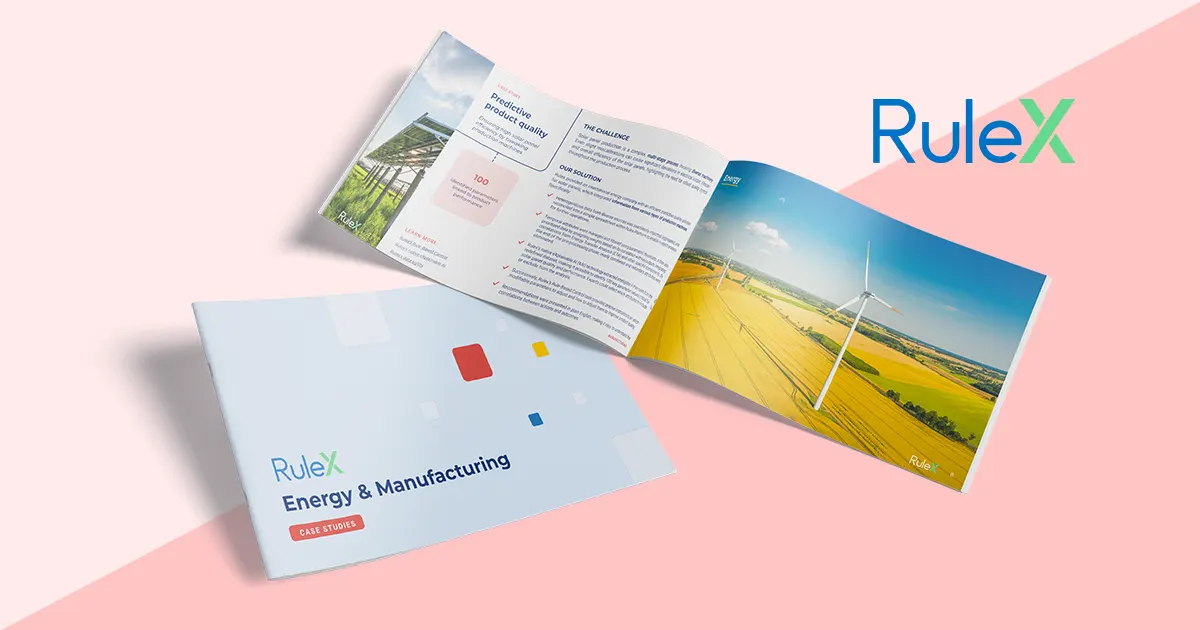
See case studies
How Rule-Based Control generates actionable plans
Building a rule-based model with XAI
Using explainable AI (XAI), Rulex Platform analyzes large historical datasets to identify the patterns that drive outcomes and expresses them as transparent if-then predictive rules.
These rules are then passed to the Rule-Based Control task, where users can define precise objectives for target attributes, assign variable weights, and select which inputs to include or exclude. All configuration is performed through an intuitive drag-and-drop interface.

Getting recommendations that change outcomes
The Rule-Based Control task provides step-by-step guidance to align results with defined targets. It recommends specific actions and explains the underlying rules in clear, plain language.
These recommendations, such as adjusting service conditions to reduce customer churn or modifying operating parameters to prevent machine failures, can be implemented manually by a human operator or executed automatically within operational systems.

Pioneering Industry 4.0
Beyond generating individual insights, Rule-Based Control delivers higher performance and lower maintenance costs than traditional scenario simulators, even in complex, networked environments.
Its speed, seamless integration with existing models, and capacity to process vast IoT datasets, make it ideal for closed-loop feedback systems, a key enabler of Industry 4.0 and digital transformation.

Real-World Impact of Rulex’s Scenario Simulator
See how Rulex converts predictive models into actionable outcomes across industries.
PREDICTIVE MACHINE MAINTENANCE
A leading manufacturer needed to anticipate failures in its trenchers and take preventive actions before breakdowns occurred. Unexpected equipment failures were significantly impacting operations and revenue, particularly given the size and complexity of the machines involved.
Rulex collected and integrated historical breakdown records, sensor data from the trenchers, and machine-monitored flags to identify patterns associated with malfunctions. Several types of alarms potentially leading to failures were identified, including those related to software anomalies, operating hours, and engine oil pressure levels. Rulex’s proprietary XAI algorithms extracted intelligible rules from this data, enabling accurate predictions of potential equipment breakdowns and their underlying causes. Through these rules and the controllable variables, the Rule-Based Control task analyzed operational parameters and generated recommended adjustments to prevent breakdowns before they occurred, such as lowering the engine speed of a specific machine. The instructions were clear and easy to follow, allowing operators to implement them directly without requiring IT intervention.
90%+ accuracy in breakdown predictions
WATER DISTRIBUTION NETWORK OPTIMIZATION
One of the largest and most densely populated cities in Italy needed to optimize the performance of its water distribution network, a complex system composed of interconnected nodes, with multiple operational variables and strict operational constraints. Managing the power allocation across pumping stations required constant monitoring, making it challenging to sustain high efficiency levels without driving up operating costs.
Rulex collected and analyzed historical data from 27 pumping stations, including flow levels, energy consumption, pressure values, and pump inverter speed. The platform identified patterns in the network’s behavior and generated 146 if–then rules describing the system’s operating conditions and performance. Through the Rule-Based Control task, precise outputs were generated to enable optimized control actions, dynamically adjusting pump status to achieve the desired network configuration. Rulex’s native explainable AI technology also made the cause-effect relationships behind water demand predictions transparent, highlighting potential inefficiencies such as an excessive number of active pumps in specific areas of the network. The forecasting process was scheduled to run every 15 minutes, providing network operators with near real-time decision support through a clear and actionable plan.
-5% energy consumption
ENERGY TRADING
A global energy provider needed to optimize intraday power trading, a highly dynamic process of buying and selling electricity that requires hourly decision-making. Traders needed advanced tools to integrate large volumes of data and support decision-making, ensuring accurate performance while maximizing profits and avoiding losses from suboptimal strategies. Rulex collected and reconciled historical data from the previous two years and imported real-time values from external sources, such as peak and minimum energy prices and demand levels, this information was used to define trading strategies for the upcoming hours. Using feature selection and multiple time windows, the platform identified patterns in market behavior and generated predictive if–then rules through Rulex’s proprietary XAI algorithm. The Rule-Based Control task ranked all possible options and suggested the optimal strategy hour by hour according to user-defined objectives (for example, to mitigate short-term risks, a rule automatically paused the strategy if the profit probability for a specific hour fell below a defined threshold). Interactive dashboards provided intelligent feedback on user strategies, enabling traders to explore alternative approaches and monitor their effectiveness over time.
440 user-applicable trading strategies analyzed in minutes
FAQs
1. What is the Rule-Based Control task?
Rulex’s Rule-Based Control is a what-if scenario simulator that goes beyond forecasting by recommending specific actions required to achieve defined objectives. Unlike traditional models that only predict what will happen, the Rule-Based Control determines what should be changed in order to change future outcomes.
2. How does it differ from traditional predictive modeling?
Traditional predictive modeling answers the question: “What will happen?”, while Rulex’s Rule-Based Control answers “What should I change to achieve a specific result?”
The task transforms predictive rules into actionable recommendations by:
- Allowing users to define target objectives
- Assigning weights to variables
- Selecting constraints and controllable features
- Generating optimized action plans
3. How does explainable AI (XAI) support Rulex’s Rule-Based Control task?
Rulex leverages natively explainable AI (XAI) to extract transparent, human-readable if-then rules from historical data, which clearly describe predictive relationships between variables. Unlike black box models, the platform generates predictions and recommendations that are fully transparent and traceable.
Because every recommendations are derived from transparent rules, users can understand not only what action is recommended, but also why it is expected to influence the outcome. This transparency enables easier validation, supports auditability, and strengthens trust in data-driven decisions.
4. Can Rule-Based Control recommendations be automatically executed?
Yes. The recommendations generated by Rule-Based Control can be implemented either manually by a human operator or automatically executed within operational systems.
Once the optimal modifications are identified, organizations can integrate the output into existing workflows, control systems, or digital infrastructures. This enables automated execution in closed-loop environments, where recommended actions are directly applied to influence outcomes.
The result is a seamless transition from analytical insight to operational action, reducing response times and minimizing the need for manual intervention.
5. How does the Rule-Based Control task reduce experimentation costs?
Rulex’s Rule-Based Control reduces experimentation costs by eliminating the need to test multiple strategies directly in operational environments.
Instead of modifying prices, process parameters, or operational settings in real life, the task simulates those changes using the predictive rules generated by the model. It evaluates in advance which actions are most likely to achieve the desired outcome.
This approach allows organizations to make informed decisions before implementation, reducing failed attempts, limiting operational risk, avoiding unnecessary resource consumption, and significantly shortening the time required to deploy effective solutions.
Related content

What Is Decision Intelligence?
How many decisions do we make every day? And how much effort is involved in making informed and logical choices? In this fast-paced world, millions of decisions must be made every minute, from sending an email to deciding how much coffee to stock for your café or determining whether the insurance claim you are reviewing involves fraud.
Enhancing performance with future-ready technology
With a comprehensive decision intelligence toolkit, including eXplainable AI, mathematical…

A Novel Rule-Based Modeling and Control Approach for the Optimization of Complex Water Distribution Networks
This work applies Rule Based Control, a new rule-based, computationally efficient…
Go beyond scenario simulation.
Discover the capabilities of Rulex Platform