

Success story
AI Data Quality for Supply Chain Master Data Management: a Self-Healing Framework
Rulex helped a Fortune 50 company build an AI data quality framework for supply chain master data, transforming periodic cleanup into a self-healing process of continuous improvement.

data accuracy
reduction in planner
time spent on master
data corrections
cleaned in under 5 minutes
parameters
managed across global
planning operations
A Fortune 50 supply chain needed to consolidate planning across more than 100 regional business units. Their planners managed up to 6,000 material-location combinations each, across more than 70 million parameters globally. Even small inconsistencies about materials, locations, sourcing relationships, or planning parameters impacted on the quality of every downstream decision, sometimes causing, at this scale, massive losses in terms of money and time.
According to Gartner research, poor data quality costs organizations an average of $12.9 million annually, underscoring the financial and strategic impact of bad data.
Building a self-healing AI data quality framework
Rulex helped the company with a solution that combined explainable AI and domain expert validation within Rulex Platform’s no-code environment.
This shifted the company from periodic data cleanup to a continuous, governed improvement process – a self-healing data quality framework that detects anomalies, generates corrective rules, and refines itself over time through these main steps:
Data integration
Supply chain data was collected and integrated from enterprise systems.
AI-Powered Anomaly Detection
Anomalies and logical inconsistencies in master data were identified, with Rulex’s proprietary explainable AI generating corrective rules and suggesting targeted remediation actions.
Expert Validation
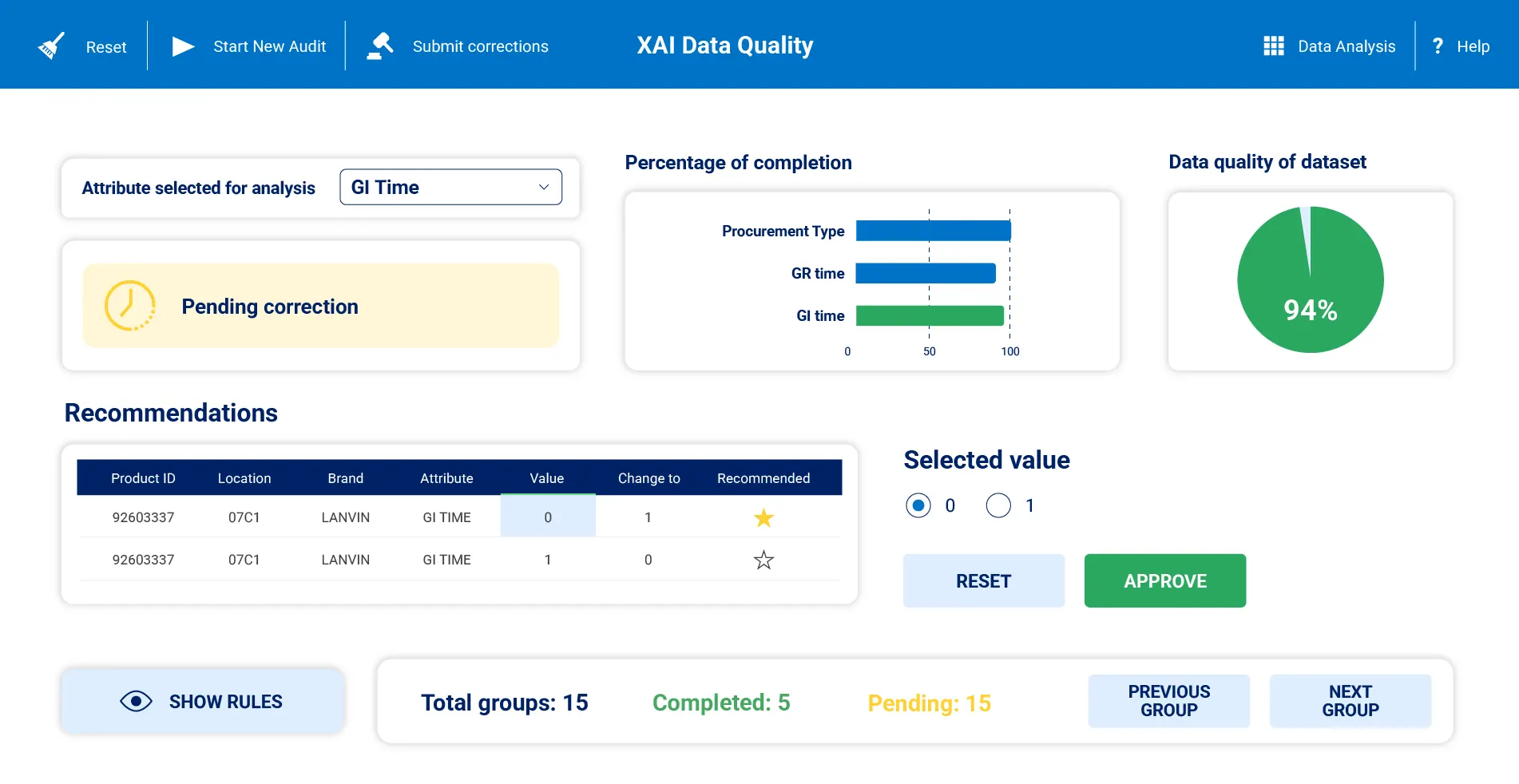
Domain experts reviewed and approved each proposed change through custom interfaces.
Data Correction
Approved corrections were written back to the source systems.
Continuous Improvement
Validated rules were reused to improve future data quality checks.
Rather than repeatedly fixing the same issues, the organization established a self-healing AI data quality process where every validation cycle contributed to more accurate and reliable master data.
Measurable impact
Over time, the self-healing framework refined its ruleset, supporting faster, more consistent planning decisions. The system kept improving the quality of supply chain master data, with expert oversight built at every step. The results were tangible:
- 5%+ profit margin improvement, confirmed through dynamic A/B testing.
- 1M records cleaned in under 5 minutes.
- 100% data accuracy.
- 86% reduction in planner time spent on master data corrections.
How Rulex delivers data quality with expert control
The use case described on this page is powered by Rulex’s Robotic Data Correction (RDC), the AI-augmented approach at the core of the self-healing framework. RDC uses explainable AI to identify logical inconsistencies, generate corrective rules from the data, and propose targeted remediation actions for expert review.
Beyond RDC, Rulex Platform also supports two additional data-quality approaches:
Traditional data cleansing – improves the quality of raw information by handling missing values and outliers, correcting syntax errors, removing duplicates, and harmonizing fragmented datasets.
Rule-based validation – allows organizations to formalize business knowledge as transparent if-then rules that can be tested, monitored, applied, and scaled across large volumes of data.
Together, these capabilities allow organizations to choose the most appropriate method for each data-quality problem.
Rulex treats data quality as a decision layer. By focusing validation efforts on decision-critical information, organizations can increase trust in their data and support more reliable operational outcomes.
Tech point
Take a closer look at the Rulex Platform capabilities behind its self-healing data quality solution.

01. Supply chain data integration and orchestration
Rulex Platform connects data from files, databases, SAP tables, cloud storage, transforming fragmented information into unified, decision-ready datasets. This creates a scalable foundation for improving data quality across systems, regions, and business units. Every transformation, validation, and aggregation step is fully traceable, making data pipelines transparent, repeatable, and easy to govern.
02. Self-healing master data
Rulex’s augmented data quality capabilities help organizations improve decision-critical master data while keeping data validation transparent and under expert control. Explainable AI detects logical inconsistencies and generates corrective rules even when predefined validation logic is unavailable. Rule-Based Control (RBC) then translates those rules into targeted remediation actions, identifying which controllable values should be changed and how. Experts can review and approve each recommendation before corrections are written back to source systems.
03. Automated write-back and continuous improvement
Validated corrections can be applied back to source systems and reused to improve future recommendations. Thanks to Rulex Platform’s integration capabilities, the data healing process can connect with existing enterprise applications, planning platforms, databases, and data pipelines, turning master data management from a periodic cleanup into a continuous, operational workflow. Solutions are easy to set up and maintain without IT intervention, putting data quality directly in the hands of the business teams who depend on it.
Why Rulex for supply chain master data quality
Supply chain data quality creates value when it protects and improves the critical information behind operational decisions. Rulex combines multiple data quality approaches, from traditional cleansing and rule-based validation to AI-augmented correction – keeping experts in control of a process that continuously improves over time. For large supply chains, that means more reliable master data and a stronger foundation for operational decision-making.


Explore more data quality services case studies powered by Rulex Platform

Accelerate System Implementation Through Data Orchestration
Preparing data to facilitate implementation of new tools.

Rule-Based Data Quality for Supply Chain Master Data
Ensuring consistent and well-structured data across the entire organization.

Manage Supply Disruptions Across a Fortune 50 Supply Network
Finding substitutions for hundreds of SKUs in minutes.
Frequently asked questions
What is self-healing data quality?
Self-healing data quality is an approach where a system continuously detects data issues, suggests corrections, learns from expert validation, and improves the business-critical data over time without requiring manual intervention at every step.
How does self-healing data support supply chain planning?
Supply chain planning depends on accurate information about materials, locations, products, and locations. A self-healing approach keeps that information accurate and current, improving the reliability of every planning output that depends on it.
What is AI data quality?
The use of artificial intelligence to identify data issues, detect hidden inconsistencies, suggest corrections, and improve the reliability of datasets used in analytics and decision-making. In Rulex, this process is powered by explainable AI, so users can understand why an issue was detected, review the logic behind each suggested correction, and keep domain experts in control of the validation process.
What is augmented data quality?
Augmented data quality refers to the use of AI and machine learning to automate and enhance traditional data quality processes, moving beyond manual, rule-based cleanup. In Rulex, augmented data quality uses explainable AI to identify logical inconsistencies and generate corrective rules that experts can review and approve.
What makes Rulex different from other AI data cleaning tools?
Many modern data quality platforms use AI to detect anomalies and suggest corrections. Rulex takes a different approach by making every recommendation explainable. Instead of opaque suggestions, Rulex generates transparent decision rules that domain experts can review, validate and refine before they are applied. As users provide feedback, the system continuously improves its recommendations. Because Rulex combines explainable AI, business rules and traditional data quality techniques within a single no-code platform, organisations can choose the most appropriate approach for each data quality challenge.