

Success story
Accelerate System Implementation through
Data Orchestration
Prepare, transform, and clean heterogeneous data for downstream systems while giving business users direct control over the entire data flow.

lower costs Vs.
Python-based alternatives
to develop the
complete solution
data aligned with
target specifications
autonomous
data flow management
A large online pharmacy had selected a widely used inventory management system for the pharmaceutical industry. Before it could be implemented, however, the company’s existing data had to be adapted to the rigid structure required by the new software.
The pharmacy operated across different countries through online marketplaces, receiving source files in multiple languages. Although the datasets contained broadly equivalent information, column names, descriptions, formats, and structures varied from one market to another. Product codes also had to conform to specific formats, while data types and field lengths needed to be aligned, datasets merged, duplicates removed, and missing values standardized.
Within a few weeks, Rulex delivered a solution covering the data preparation, transformation, and quality requirements needed to move forward with the new inventory management system.
From fragmented source files to a system-ready dataset
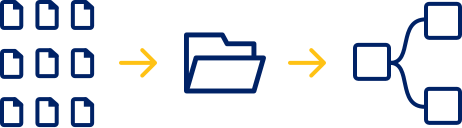
The process began by bringing multilingual files from different markets into a common structure. Instead of importing and combining each dataset individually, entire folders could be processed together, with newly added files automatically incorporated into the same flow. Information about the source file could also be retained as an additional attribute, preserving context such as the country associated with each record.
Import problems became visible as files were ingested. If an inconsistency prevented a file from being parsed correctly, users could identify the issue immediately and investigate it directly. Compared with a script-based process, where locating the problematic file or record may require additional investigation, this made troubleshooting considerably more immediate.
Once consolidated, the data could be reshaped according to the inventory system’s specifications. Pharmacy employees adjusted field names and data types, standardized product codes and field lengths, and combined information using built-in configurations and simple formulas. Multiple transformations could be carried out within the same visual environment rather than implemented as a collection of separate scripts.
Data quality formed the final part of the preparation process. Missing values, inconsistencies, and duplicate records were identified and resolved before the information was passed to the new inventory system.
Once the required operations had been configured, new incoming files could follow the same preparation logic automatically. Employees could therefore manage the data flow themselves without ongoing maintenance or the need to develop new custom scripts as files arrived.
The impact
Over time, the self-healing framework refined its ruleset, supporting faster, more consistent planning decisions. The system kept improving the quality of supply chain master data, with expert oversight built at every step. The results were tangible:
- 20% lower costs compared with Python-based alternatives.
- Continuous file ingestion, with new files automatically incorporated as they became available.
- Data issues made visible during import for immediate troubleshooting.
- Autonomous data flow management, without ongoing maintenance or custom scripts.
Tech point
Take a closer look at the Rulex Platform capabilities behind this data agility solution.

01. Data orchestration that removes repetitive work
Rulex Platform can collect and aggregate information from heterogeneous files, databases, cloud storage, and enterprise repositories within a single data flow, converting incoming data into a common format for further processing. Dedicated import tasks support formats such as Excel, CSV, JSON, XML, and Parquet, as well as local and remote sources.
Connections can be configured as Saved resources, stored at environment level and reusable across different tasks and flows, or as Custom connections, defined specifically for the task in which they are used. Single files, multiple files, or entire folders can be ingested and combined into datasets, supporting recurring data preparation across large volumes of information. By automating these activities, teams can spend more time on analysis, optimization, and forecasting rather than repeatedly collecting and preparing data.
02. WYSIWYG data transformation
Rulex Platform provides a visual drag-and-drop environment for building data workflows, while a WYSIWYG interface lets users work directly with the information they are transforming. Multiple preparation operations can be configured without writing custom scripts, from structural changes and derived attributes to filtering, joining, and data quality operations.
Behind the visual interface, Rulex Platform generates optimized code for every operation, automatically documenting the steps performed and supporting source-control versioning. Each operation is also recorded in an interactive history, where individual steps can be reviewed, modified, and repeated. This combines the accessibility of visual data preparation with the traceability needed to debug, maintain, and evolve workflows over time.
Why Rulex for data transformation
Rulex brings data ingestion, transformation, and quality management into configurable, reusable workflows that business users can manage directly as data and requirements evolve.


Explore more data management case studies powered by Rulex Platform

Rule-Based Data Quality for Supply Chain Master Data
Ensuring consistent and well-structured data across the entire organization.

AI Data Quality for Supply Chain Master Data Management
Combining XAI with expert input for continuous rule refinement.

Forecast Pharmaceutical Demand in a Changing Market
Estimating demand to align supply with market needs.
Frequently asked questions
How does Rulex handle data from different sources and formats?
Rulex can collect and aggregate information from heterogeneous data environments through dedicated tasks. Its connectivity spans files, databases, cloud storage, and enterprise repositories, allowing information from different sources and formats to be brought into unified datasets for transformation, quality checks, and downstream use.
How does Rulex make data transformation easier for business users?
Rulex provides a no-code, drag-and-drop environment with WYSIWYG data interaction, allowing users to work directly with the information they need to transform. In this project, pharmacy employees independently handled structural changes and data quality operations without relying on custom scripts.
How does Rulex help identify problems during data ingestion?
Import and parsing issues are surfaced as data is ingested, giving users immediate visibility into problematic files and making it easier to locate and troubleshoot inconsistencies than in a script-based processing flow.
Can existing Python or R scripts still be used with Rulex?
Yes. Rulex Platform can incorporate external Python and R scripts into its workflows, allowing organizations to retain existing code where it adds value while using Rulex capabilities for the surrounding data preparation and orchestration process.